



I’ve been thinking about veggie snacks lately, and not in the way you’d expect.
See, there’s this weird cultural thing that’s happened where we’ve all collectively decided that “veggie snacks” automatically means “virtuous suffering.” Like, the moment you reach for something made from vegetables instead of potatoes fried in questionable oil, you’re making a noble sacrifice. You’re being good. You’re doing your penance for that family-size block of Cadbury you demolished last Tuesday.
Which is completely backward, if you think about it.
Because some of the best snacks I’ve had in the past couple of years have been vegetable-based. Not “good for veggie snacks.” Just good. Full stop. The kind of thing you’d actively choose over the alternative, not the thing you force yourself to eat while staring longingly at the biscuit tin.
And yet nobody talks about them that way. It’s all guilt and virtue signalling and “being healthy,” when really, we should be talking about the fact that roasted chickpeas with the right seasoning are genuinely more satisfying than a bag of chips that leaves you feeling like a deflated balloon twenty minutes later.
So let’s talk about veggie snacks. But let’s talk about them honestly, without the weird moralising that usually comes attached.
The Problem With How We Think About Vegetables
Here’s what nobody wants to admit: plain vegetables, on their own, can be spectacularly boring.
There. I said it.
A raw carrot is fine. It’s crunchy. It’s orange. It exists. But it’s not exactly exciting. Same with celery, which is basically crunchy water with delusions of grandeur. Or cucumber, which is just… wet. Refreshing, sure, but hardly thrilling.
And this is where we’ve gone wrong with veggie snacks. We’ve treated vegetables like they should be inherently delicious on their own, and when they’re not, we’ve decided that’s our fault for having corrupted taste buds. Like we need to retrain ourselves to appreciate the subtle beauty of a plain raw broccoli floret.
Which is nonsense.
Vegetables aren’t meant to be eaten plain. They’re meant to be a vehicle for flavour. They’re the canvas, not the painting. And once you understand that—once you stop treating vegetables like some sort of dietary punishment—the whole thing becomes a lot more interesting.
What Actually Makes a Veggie Snack Good
I’ve been eating a lot of veggie snacks lately. More than I probably should admit. And I’ve noticed something: the ones that work, the ones I actually reach for without thinking about it, all have a few things in common.
They’re properly seasoned. Not timidly seasoned. Not “health food store worried about sodium” seasoned. Actually, properly seasoned. Salt matters. Fat matters. Spices matter. The vegetables are just the structure—the seasoning is what makes them worth eating.
They have texture. Crispy, crunchy, something that makes a satisfying sound when you bite into it. Because let’s be honest, half the appeal of snacking is sensory. Nobody wants to eat something that feels like it’s already given up on life. That’s exactly why mushroom crisps can work so well when they get the crunch right.
They’re convenient. This is crucial. If your healthy snack requires seventeen steps and a food processor while the Tim Tams are just sitting there in the cupboard, which one do you think wins?
They don’t taste like compromise. This is the big one. The best veggie snacks don’t taste like the thing you’re eating instead of what you really want. They taste like the thing you actually want.
The Ones That Actually Work
I’m not going to give you a comprehensive list of every veggie snack ever invented. That would be boring, and also pointless, because half of them taste like cardboard anyway.
Instead, here are the ones I’ve actually found myself buying repeatedly, the ones that have earned permanent real estate in my pantry.
Roasted chickpeas are probably the gateway drug. They’re crunchy, they’re filling, they come in approximately forty-seven different flavour variations, and most importantly, they don’t taste like you’re being virtuous. They just taste good. The honey and cinnamon ones are particularly dangerous—I’ve gone through an entire bag without noticing more times than I’d like to admit. The Happy Snack Company Chocolate Roasted Chickpeas are another example of how roasted chickpeas can feel more like a proper snack than a “healthy alternative.”
Kale chips get a bad rap for being too “inner-city cafe,” which is fair, but also misses the point. Done properly—with actual seasoning, not just optimistic thinking—they’re genuinely good. Salty, crispy, weirdly moreish. The trick is finding brands that understand flavour isn’t optional.
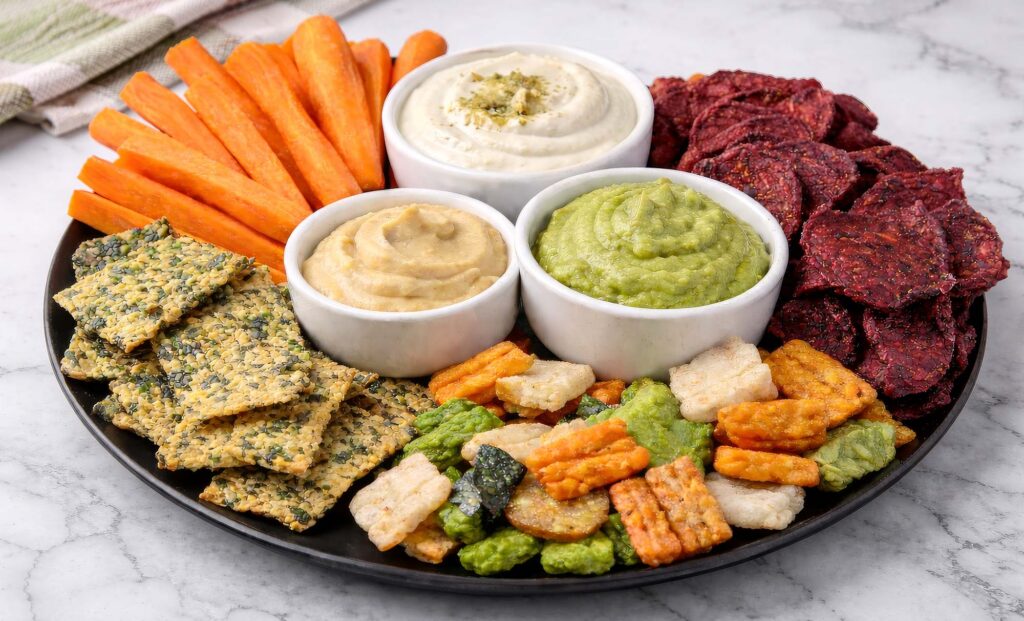
Beetroot chips are what happens when someone finally realises that beetroot doesn’t have to be that weird slimy thing in your salad. Thinly sliced, properly roasted, with a bit of sea salt—they’re sweet, they’re earthy, they’re satisfying in a way that regular chips aren’t.
Seaweed snacks sound absolutely cooked until you try them. They’re basically the ocean in chip form. Salty, umami, crispy, and roughly equivalent to eating flavoured air in terms of calories, which means you can demolish an entire packet without the crushing guilt that usually follows.
Veggie sticks with proper dip only work if you’re honest about the dip situation. Nobody wants a sad carrot stick on its own. But that same carrot dunked in good hummus? Different story entirely. The vegetable is just the delivery mechanism. The dip is the point.
The Dip Question
Speaking of dips, let’s talk about this honestly.
The right dip can make literally anything edible. I’m convinced you could dip a piece of cardboard in good baba ganoush and it would be at least moderately enjoyable. (Please don’t try this.)
Hummus is the obvious choice because it’s good and it’s available everywhere and it comes in roughly ninety-three different flavours now. Classic is classic for a reason, but the roasted red capsicum version is quietly superior and I’ll defend that position.
Tzatziki is what you eat when it’s too hot to exist and you need something cool and refreshing and vaguely Greek. Pairs brilliantly with cucumber, which otherwise has no real purpose in life.
Guacamole works with everything because avocados are magic and anyone who disagrees is wrong. The creaminess makes even the most boring vegetable interesting.
Baba ganoush is underrated. It’s got that smoky depth from the roasted eggplant, and it makes you feel sophisticated even though you’re just standing in your kitchen eating raw capsicum at 11pm.
The dip is doing most of the heavy lifting here, and that’s fine. That’s the whole point. The vegetable is just the socially acceptable way to eat an entire tub of dip without using a spoon.
Making Your Own (When You Can Be Bothered)
I make my own veggie snacks sometimes. Not often, because I’m lazy and buying them is easier, but sometimes.
Roasted chickpeas are stupidly simple. Drain a tin, dry them properly (this is crucial—wet chickpeas won’t crisp up), toss with oil and spices, roast at 200°C until they’re crunchy, try not to eat them all while they’re still hot. I’ve made them with curry powder, with smoked paprika, with honey and cinnamon, with whatever random spices were sitting in the cupboard. They’ve all worked.
Oven-roasted veggie chips require a mandoline or a very steady hand and a lot of patience. Slice vegetables thin, toss with minimal oil, season generously, spread out on a tray, roast until crispy, resist the urge to eat them before they’ve cooled. Sweet potato works, beetroot works, parsnip works surprisingly well, kale works if you’re careful.
The advantage of making your own is control. You decide how much salt, what spices, whether to add chilli or keep it simple. The disadvantage is that it requires actual effort, and sometimes you just want to rip open a packet and be done with it.
Both approaches are valid.
Why This Matters (Or Doesn’t)
I’m not trying to convince you that veggie snacks are morally superior to regular snacks. I’m not interested in that conversation. Eat what you want. Life’s too short to stress about whether your afternoon snack is virtuous enough.
But if you’re looking for something that’s genuinely satisfying, that doesn’t leave you feeling terrible afterward, that you’d actually choose rather than just tolerate—veggie snacks have come a long way. They’ve evolved beyond sad celery sticks and into something worth paying attention to.
The ones that work understand that vegetables need help. They need seasoning, they need texture, they need to be treated like food rather than punishment. And when you find the ones that get that right, they’re not a compromise. They’re just good.
Chews It has a range of veggie snacks that seem to understand this. Not all of them, probably—I haven’t tried everything—but enough that they’re worth looking at if you’re in the market for something that doesn’t taste like you’re being virtuous.
And really, that’s all I’m after. Snacks that taste good. Whether they happen to be made from vegetables is secondary.